
Guardsman Air Duct Cleaning in Boulder: A Homeowner’s Guide
Guardsman duct cleaning, when it arrives through a furniture or home warranty program, usually covers the visible supply registers and not much else. The main trunk lines, the return plenum, and the air handler behind the furnace are typically outside the scope. That’s not a scam, it’s just a narrow job described with a broad word. Before you schedule the visit or accept the “complimentary” add-on, it helps to know exactly what you’re getting and what a full-system cleaning in Boulder actually requires.
If you’d rather not sort through program paperwork to figure out scope, call (833) 554-4046. We answer 24/7, and fast dispatch runs from 7am to 7pm, Sunday through Friday. Estimates are free.
What does Guardsman duct cleaning actually include?
Guardsman-branded duct cleaning is a protectant and cleaning program, usually sold through furniture retailers or folded into a home warranty package. When a duct cleaning visit is included, the technician typically cleans the supply registers and the first short run behind each one. That’s the whole scope in most cases. Return grilles, the main trunk feeding the branch runs, and the air handler cabinet are not part of the standard package.
Think of it like cleaning the vents in each room but leaving the hallway and the basement untouched. Air still moves through all of it, every cycle, so the parts you didn’t clean keep feeding debris back into the parts you did.
A full-system cleaning at the standard our industry works to covers:
- Every supply register and the branch run behind it
- Every return grille and return plenum
- Main trunk lines in both directions from the air handler
- The air handler and blower cabinet
- The furnace heat exchanger area and evaporator coil face, where accessible
That difference matters more in Boulder than in most places, because the local contamination load isn’t mild.
Why does package-program cleaning use portable vacuums instead of negative pressure?
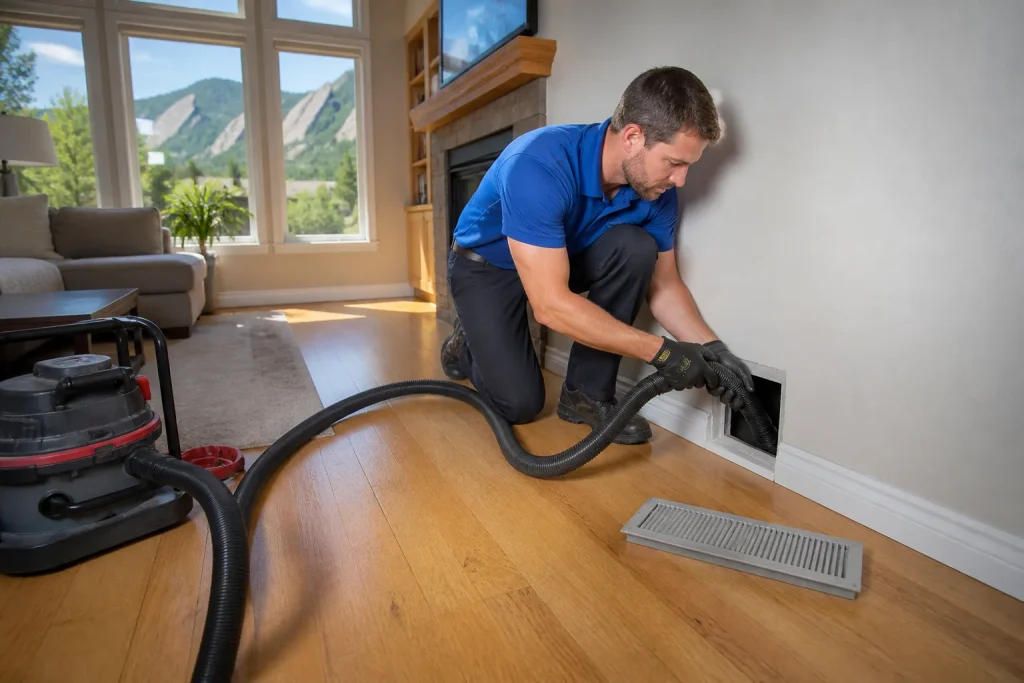
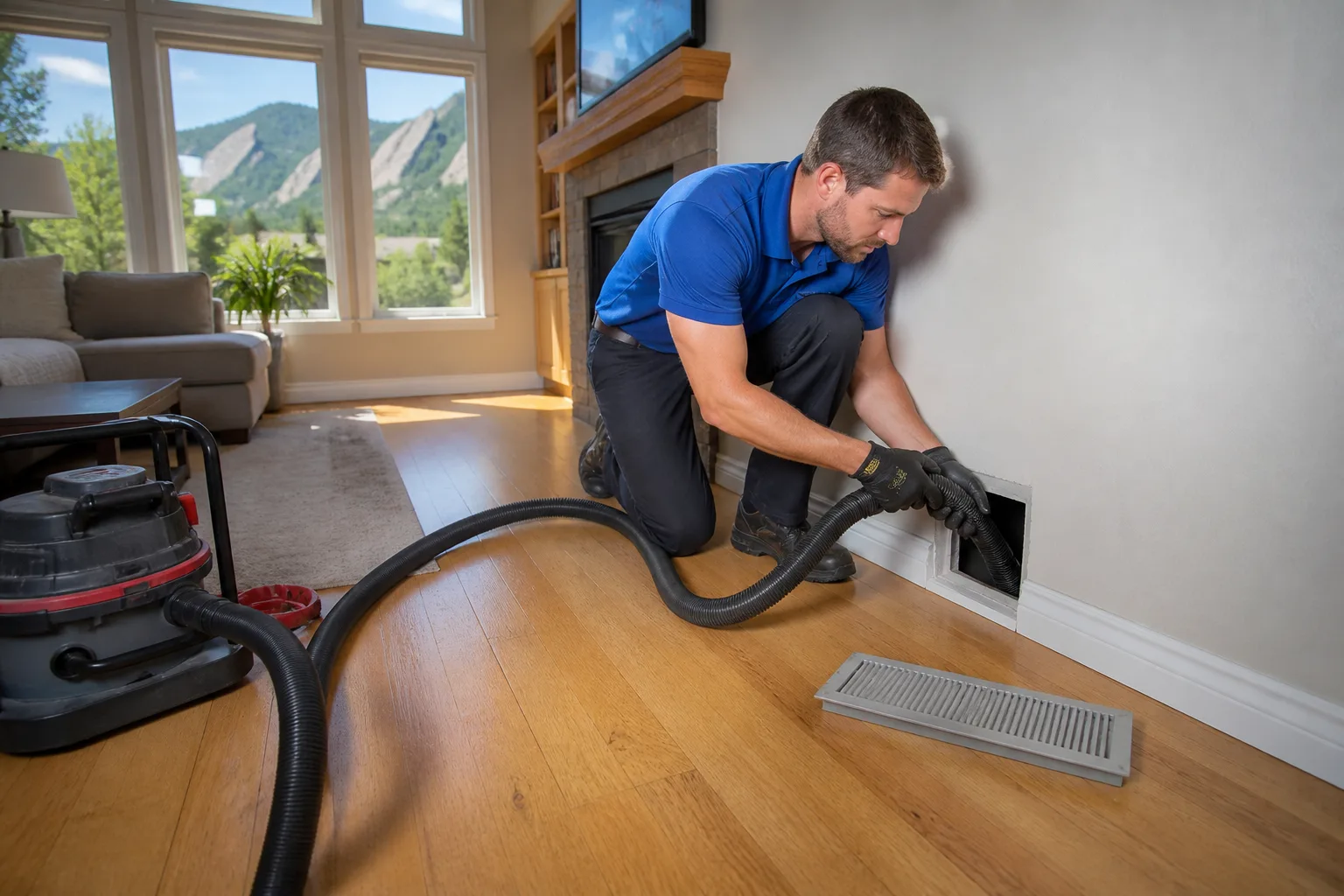
Most package-program cleanings pull a portable vacuum into the house and run a hose down each register. It’s fast, it fits in a compact vehicle, and it’s honest for a register-only job. What it cannot do is put the whole duct system under negative pressure, which is the only reliable way to stop loosened debris from drifting back into living space while it’s being disturbed.
A full-system cleaning typically uses two things a portable unit doesn’t have:
- High-volume negative pressure at the main trunk or plenum, holding the entire system under suction so all loosened material moves toward the collection point instead of into the room.
- HEPA-level filtration and containment, so exhaust air is scrubbed before it returns to the house, and any opening into the system is sealed while work is in progress.
We run Rotobrush and Nikro duct cleaning systems with HEPA filtration, and we set up Abatement Technologies containment and negative-air equipment during service, the same standard applied in remediation work. If a technician arrives with a shop-style vacuum and no containment, the job is a surface wipe, not a system cleaning. That’s worth knowing before you compare quotes, because the price difference usually explains itself once you see the equipment.
What Boulder-specific factors make a limited-scope cleaning risky?
Boulder sits at high altitude, and the HVAC system here cycles harder to hold temperature than systems at sea level. More cycles mean more air moving through the ducts per heating season, and more air moving means more of whatever is sitting in the system gets delivered into rooms. Fine particulate that would stay put in a milder climate keeps getting picked up and blown around.
Then there’s wildfire season. Boulder County has had ash infiltration events that push fine particulate into homes even with windows closed, and return-side ductwork acts as a settling chamber for it. Ash is light, it clings to duct walls, and it re-enters the airstream each time the blower runs. Cleaning the supply registers only leaves the return side and the trunk lines loaded with the material that matters most.
And Boulder’s housing stock runs from older homes with sheet-metal ductwork and visible seams to newer builds with flex runs in tight chases. Older metal systems collect debris along the bottom of horizontal runs. Flex systems trap it in the corrugations. Either way, the accumulation is in the trunk, not at the register.
How do you read the service report Guardsman leaves behind?
The service report is the only record of what was actually done. Most homeowners glance at it, see a checkmark, and file it. Read it properly and you’ll know whether the work matched the marketing.
What a report from a full-system cleaning should show:
- Before-and-after photos of the inside of the trunk line and the air handler, not just the register grille on the wall.
- The specific components serviced, listed by name: supply runs, return plenum, main trunk, air handler, blower.
- Containment setup noted, if negative air equipment was used.
- Condition notes, if the technician found disconnected runs, crushed flex, or a leaking seam. Those are repairable and worth flagging.
What a limited-scope report typically shows: a count of registers, a signature, and nothing else. No photos of the duct interior, no component list, no condition notes. If you accepted a package-program visit and the report looks like that, you’ve now got a clear picture of what was and wasn’t done. That’s useful, not a reason to panic. It’s just an accurate inventory.
What should you ask before the Guardsman technician arrives?
Ask these five questions before the visit, and you’ll know exactly what you’re getting before anyone opens a panel:
- Which components are included? Supply registers only, or trunk lines, returns, and air handler as well?
- What equipment is coming? A portable vacuum, or a negative-pressure system with HEPA filtration and containment?
- Will I get interior photos before and after? Register grille photos are not enough.
- Is the air handler cabinet included? That’s where a lot of fine dust collects and settles.
- Who repairs anything found during the visit? If a run is disconnected, crushed, or leaking, the cleaning won’t fix it.
If the answers point to a register-only scope, that’s still a reasonable service if it’s what you expected and it fits your budget. If you want the full system done, you now know exactly what to ask for from any provider, including us.
When to call a pro
If you’re comparing package-program cleanings against a full-system standard and you want the whole duct ecosystem addressed, that’s our line of work. Our air duct cleaning covers the full trunk-and-branch system with the equipment and containment the job requires. If a technician finds disconnected or leaking runs during cleaning, we also handle HVAC cleaning and sealing so the root cause doesn’t refill the system.
Our technicians have up to 13 years of experience, and we work with Honeywell and Aprilaire products when the cleaning reveals a case for filtration or humidity control. One flat price per system, agreed before work starts, and before-and-after photos of your own ducts when we’re done.
Related services in Boulder: dryer vent cleaning, for a system that quietly builds up lint and is worth inspecting alongside the ductwork.
The Bottom Line
Guardsman duct cleaning through a warranty or furniture program usually covers the supply registers and little else. That’s fine as a light service, but it doesn’t touch the trunk lines, return plenum, or air handler, which is exactly where Boulder’s fire-season ash and high-altitude cycling load up. Read the report, ask the five questions, and decide with your eyes open.
If you’re in Boulder and need help, Boulder Air Duct Cleaning Pros offers free estimates. We answer 24/7, fast dispatch runs from 7am to 7pm, Sunday through Friday, and the written estimate sets the final price. Call (833) 554-4046 to schedule.
Frequently Asked Questions
Usually not. The standard scope covers supply registers and the first short run behind each, and typically skips return grilles, trunk lines, and the air handler. If you want the full system cleaned, you’ll need a service that specifies trunk-and-branch coverage. Call (833) 554-4046 for a free estimate on a full-system job.
Portable vacuums collect debris at the register but can’t hold the whole duct system under suction, so loosened material can drift back into rooms. Negative-pressure cleaning holds the system under suction and scrubs the exhaust air through HEPA filtration and containment. The second is the standard for a real system cleaning. Call (833) 554-4046 to talk through what your Boulder home needs.
Because they usually cover a smaller scope. A register-only cleaning with a portable vacuum takes less time, uses less equipment, and costs less to deliver. The number isn’t wrong, it’s just for a different job. Ask what’s included component by component before you compare prices. Call (833) 554-4046 for an honest whole-system range and a free estimate.
Ask for before-and-after photos of the inside of the trunk line and air handler, plus a written list of components serviced. If a report only counts registers and has no interior photos, the scope was narrow. Get it in writing, either way. Call (833) 554-4046 if you’d like to see what a full-system report looks like.
Written by the team at Boulder Air Duct Cleaning Pros.
Need Air Duct Cleaning Help?
Call Boulder Air Duct Cleaning Pros - the local pro we connect you with is licensed and insured, with free written estimates in Boulder.
(833) 554-4046